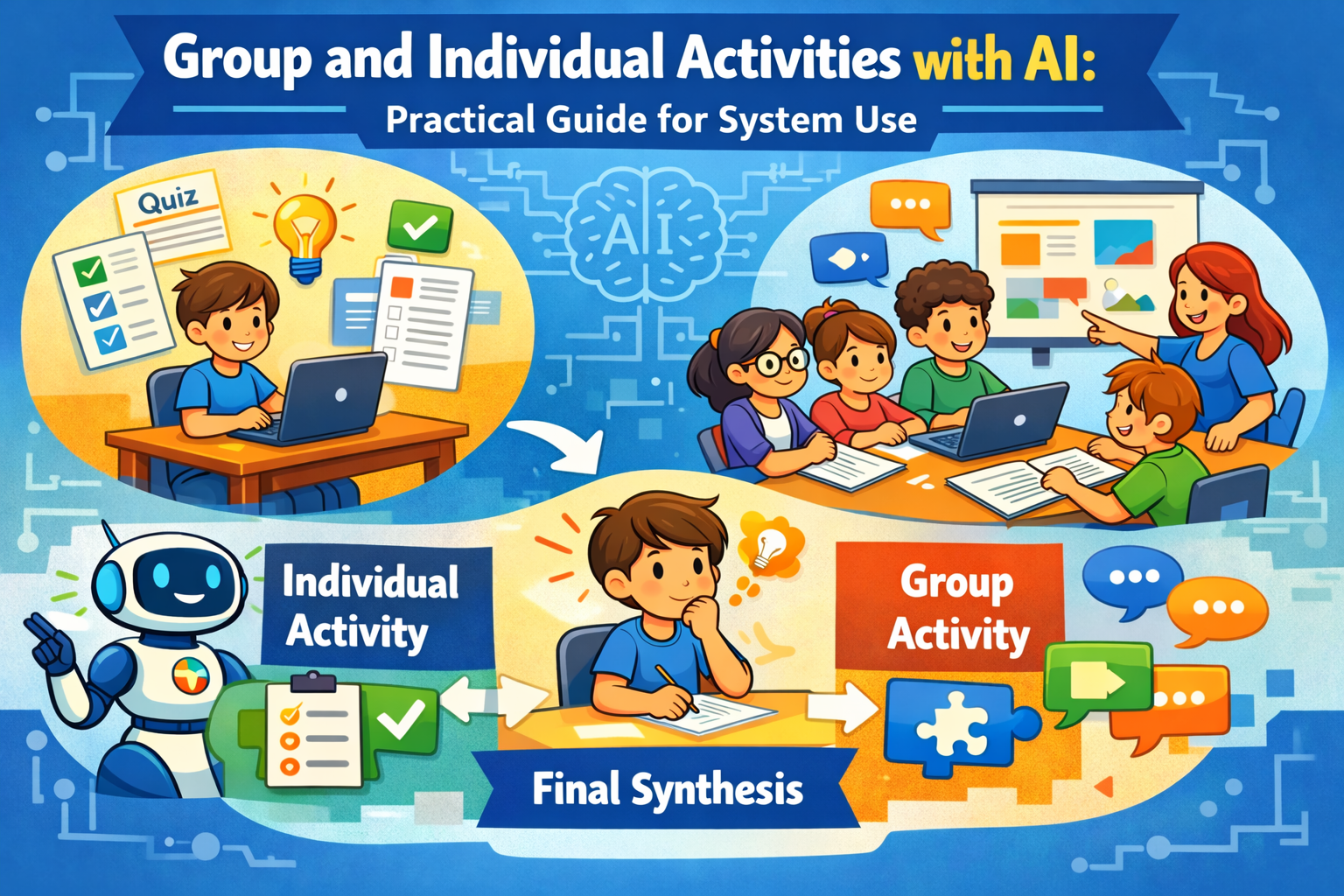
Group and individual activities with AI can be strategically planned to develop autonomy, collaboration, and learning evidence within the educational system. The choice between individual and group work is more than an organizational matter; it is a didactic decision with a direct impact on the type of learning promoted. Academically, individual activities tend to strengthen autonomy and authorship, while collective activities foster collaborative and argumentative competencies.
How to Plan Group and Individual Activities with AI
In the system, efficient planning begins with defining the objective and the nature of the evidence. If the focus is to verify individual conceptual mastery, the activity should prioritize original production and clear performance criteria. If the focus is on solving complex problems, a group format tends to be more appropriate.
A recommended practice is to start with a guiding question and an expected outcome. Subsequently, the teacher defines which system resources will be used at each stage and which indicators will be observed during execution.
Individual Activities with AI in the Educational System
For individual activities, resources such as Quizzes and Learning Paths, Essay Graders (focused on standardized exams like ENEM), and Text Rewriters assist in the progressive consolidation of knowledge. This toolkit facilitates the diagnosis of specific gaps and allows for more precise interventions per student.
It is also possible to combine Video and Audio Summaries with guided study, reducing cognitive load and improving content retrieval before assessments.
Group Activities with AI in the Educational System
For group activities, the system can support collective production with Slide Creators, contextual material creation, Didactic Image Generators, and support for structuring deliverables. This design increases the clarity of the collaborative process and improves argumentative quality.
When the teacher defines explicit roles, stages, and criteria, the group works with a more balanced level of participation. Technology serves as a methodological support, rather than a replacement for pedagogical mediation.
Hybrid Sequence: Individual + Group + Individual Synthesis
A methodologically robust approach is the three-step hybrid sequence:
- Individual preparation (initial study and recording);
- Group execution (guided collaborative production);
- Final individual synthesis (metacognition and individual accountability).
This design reduces participation asymmetry and improves learning traceability, as it combines both individual and collective evidence.
Evaluation Criteria and Pedagogical Monitoring
In assessment, it is recommended to separate dimensions:
- Individual: Focus on mastery, coherence, and progression;
- Group: Focus on cooperation, argumentative quality, the proposed solution, and the integration of contributions.
With teacher mediation and explicit criteria, group and individual AI activities cease to be competing formats and instead function as complementary learning strategies.
Common Mistakes When Applying Group and Individual AI Activities
A frequent error is mixing evaluation criteria between the collective product and individual performance without making this explicit to the class. Another issue is underutilizing individual stages, which encourages “free-riding” in group work. Finally, when AI is used without authorship rules, the risk of generic responses increases.
To avoid these pitfalls, combine partial individual submissions, logs of group contributions, and a requirement for a personal synthesis at the end. It also helps to establish clear boundaries: AI can support outlining and revision, but the final argumentation must be anchored in the student’s evidence and decisions, with teacher mediation when necessary.
FAQ: Group and Individual Activities with AI
1) Which format generates better learning: individual or group? It depends on the objective. Conceptual learning may require an individual focus, while complex competencies benefit from collaborative work.
2) How can I prevent a few students from doing all the work in group activities? The combination of individual stages and process criteria helps distribute responsibility and makes participation assessable.
3) Is it possible to use AI without harming student authorship? Yes. By requiring justifications, references, and personal synthesis, AI acts as a support tool, not a replacement for intellectual production.
4) How do I organize fair assessment in mixed activities? The recommended practice is to use distinct criteria for the collective product and individual performance, with pre-defined weights.
5) What is the best frequency for group activities? There is no single frequency; the ideal is to alternate formats according to the curriculum unit objectives and the class profile.