
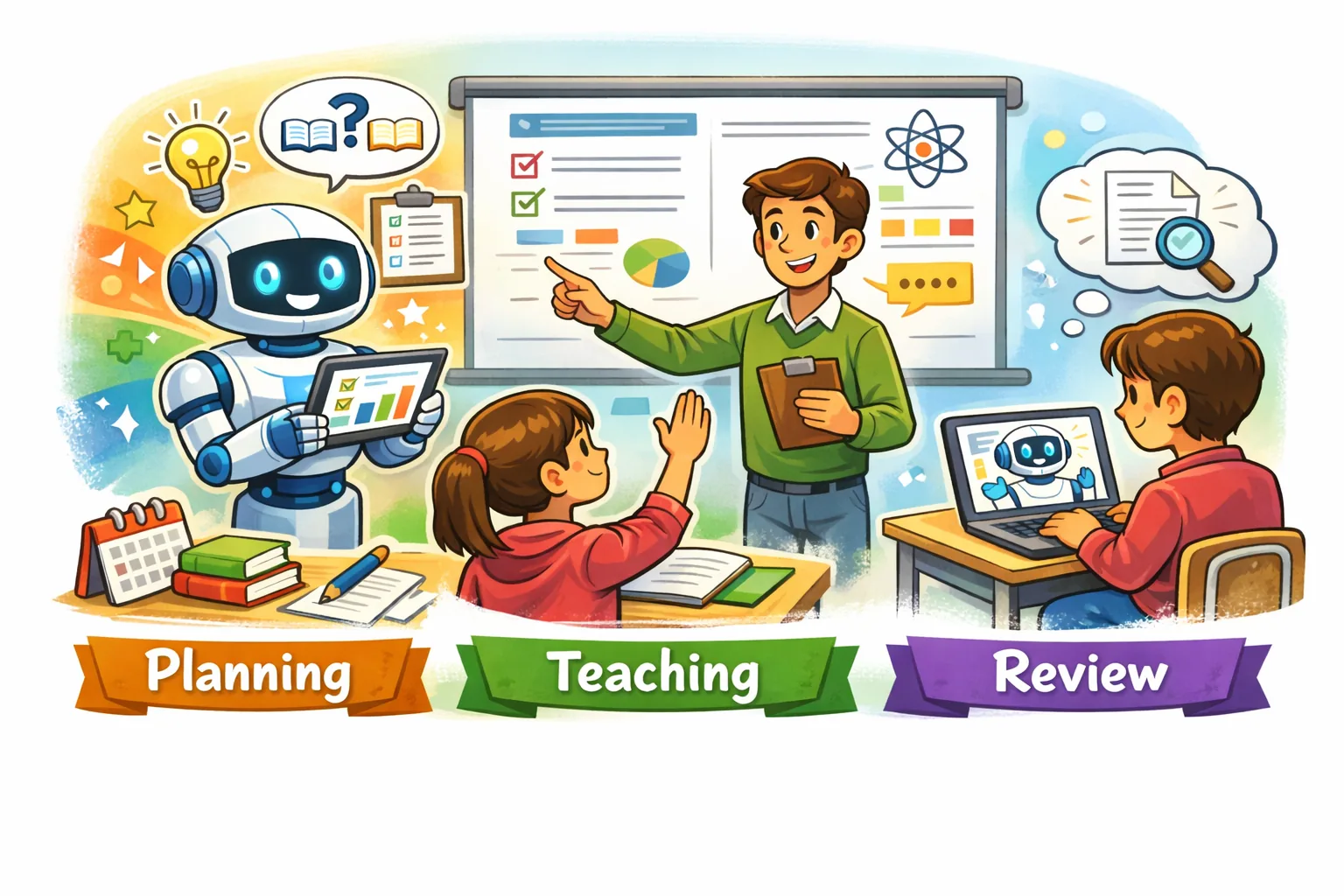
An AI assistant in the classroom can support planning, facilitation, and review when integrated with clear pedagogical objectives and guided by teacher mediation.
The integration of artificial intelligence assistants into the school context has been consolidating as a strategy to enhance pedagogical practice. From an academic perspective, the use of an assistant should not be understood as a replacement for teaching, but as an expansion of the capacity for planning, facilitation, and monitoring learning.
How to Use an AI Assistant in the Classroom with Measurable Objectives
The first step for effective use is to define measurable learning objectives. Without this, technology tends to be used superficially. When the teacher establishes competencies, skills, and expected evidence, the AI assistant in the classroom becomes a methodological support tool.
During the planning phase, teachers can use the system to structure instructional sequences, organize content, and propose coherent assessment strategies. The main benefit lies in reducing time spent on mechanical preparation, allowing greater investment in high-value pedagogical decisions, such as adapting to the class profile and differentiating by performance level.
Pedagogical Planning with an AI Assistant in the Classroom
During the lesson, the assistant can support facilitation through conceptual rephrasing, additional examples, and comprehension-check questions. This functionality is especially relevant in heterogeneous classrooms, where the same explanation does not equally serve all students. In this context, the AI assistant in the classroom contributes to cognitive accessibility, provided it is accompanied by teacher supervision.
After the lesson, the system supports knowledge consolidation through synthesis and review resources. Organizing content into visual structures and review activities tends to increase retention and transferability, especially when combined with formative feedback.
Best Practices for Implementing an AI Assistant in the Classroom
From a methodological standpoint, it is recommended to adopt a continuous cycle: plan with intention, facilitate with critical thinking, and review based on evidence. This cycle prevents purely instrumental uses with little impact and aligns technology with a well-grounded pedagogical practice.
In summary, the AI assistant in the classroom enhances the teaching experience when integrated into a robust instructional design. The teacher remains central; AI acts as a support tool to improve clarity, engagement, and consistency in the teaching-learning process.
FAQ About AI Assistant in the Classroom
1) Can an AI assistant replace the teacher in the classroom?
No. Pedagogical mediation, sociocultural contextualization, and formative assessment are inherently teaching responsibilities.
2) At which stage of the lesson does an AI assistant have the greatest impact?
Impact tends to be greater when its use spans the entire instructional cycle: planning, lesson delivery, and review.
3) How can student dependency on ready-made answers be avoided?
It is recommended to require justification, source comparison, and original production based on AI-generated inputs.
4) Does this use improve learning in a proven way?
There are gains when usage is methodologically guided and linked to learning indicators, not just productivity.
5) What is the most common implementation mistake?
Using AI without clear pedagogical objectives, treating the tool as an end in itself rather than a means for teaching.